
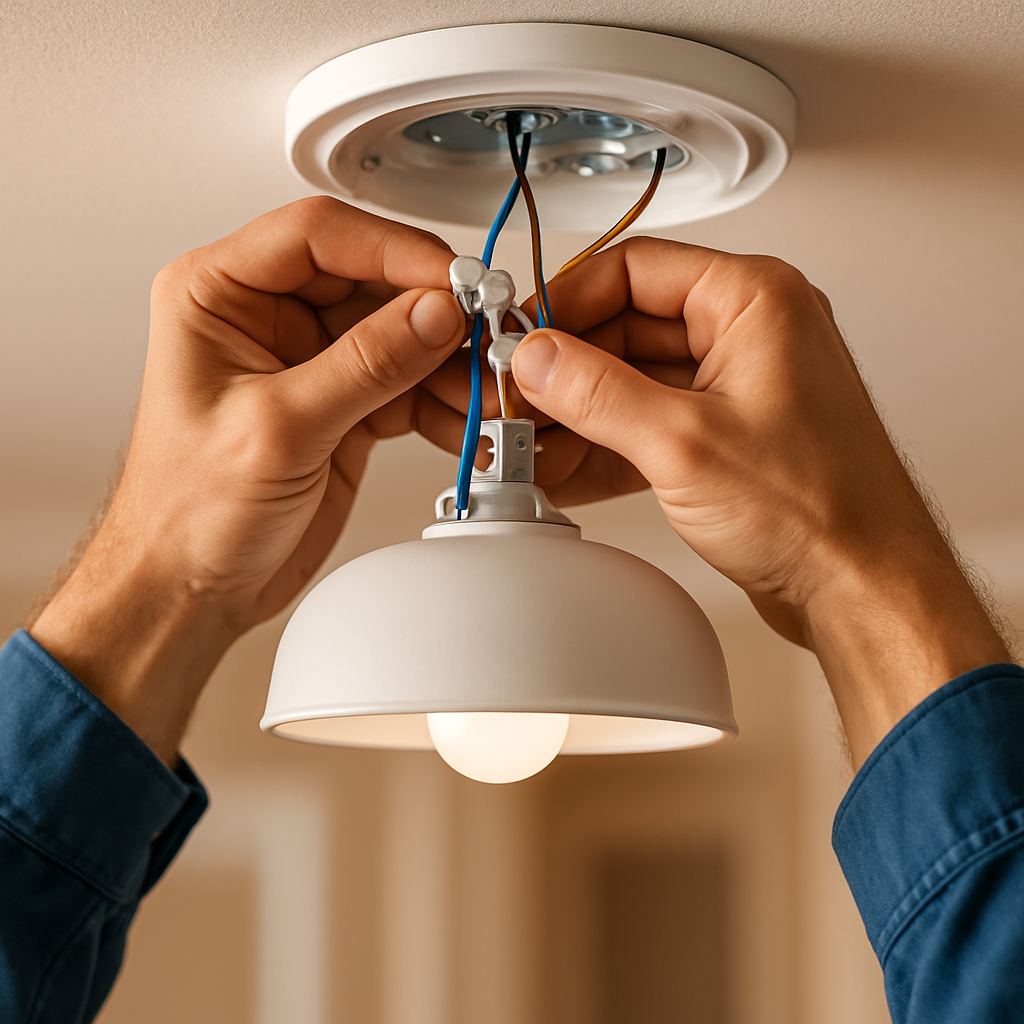
Lighting Upgrades for Your Home: Brighten Every Room, Improve Safety & Save Energy
Key takeaways:
- Upgrading old lighting or adding more lighting options is a quick and affordable home upgrade.
- You still need a licensed electrician to properly wire the new lighting.
- My Licensed Contractor can match you with a local vetted electrician for your lighting upgrade project.
A lighting upgrade is a budget-friendly project that can instantly make your home more comfortable. Depending on the project, you can also reduce your energy bills or highlight design features inside and outside of your home.
Whether you want better task lighting in a home office, modern recessed lights in the kitchen, landscape lighting along walkways, or smart controls you can manage from your phone, a licensed electrician can help create a safer, more functional lighting plan for your home.
Why Upgrade Your Home’s Lighting?
Many homeowners think about lighting only when a bulb burns out or a fixture starts to look dated. But a well-planned lighting upgrade can improve how every room and outdoor space looks, feels, and functions.
Better Lighting Improves Everyday Living
Lighting has a direct effect on how easily you can use your home. A dim kitchen can make food preparation harder. Poor lighting around a bathroom vanity can create shadows while shaving or applying makeup. Dark hallways, closets, and stairways can be frustrating—and may create safety concerns.
Upgrading fixtures, adding lights where they are needed, and improving switch placement can make daily activities easier. Brighter, more balanced lighting helps with:
- Reading, working from home, and doing homework.
- Cooking, food preparation, and cleaning.
- Getting ready in the morning or winding down at night.
- Completing laundry, storage, hobby, and DIY tasks.
- Moving safely through hallways, stairways, garages, and entryways.
Lighting upgrades can also refresh an older home without requiring a full renovation. Replacing a dated ceiling fixture, adding recessed lighting, or installing under-cabinet lights can give a room a more modern appearance while improving function at the same time.
Just as importantly, lighting can help create the right atmosphere. Dimmable fixtures in a dining room, warm bedside lighting, accent lighting around a fireplace, and pendants over a kitchen island can make a room feel more inviting and intentional.
New Lighting Can Help Lower Energy Costs
Switching from older incandescent or halogen bulbs to LED lighting is one of the simplest ways to reduce lighting-related energy use. LEDs provide strong, reliable light while using much less electricity than older bulb types. ENERGY STAR states that LEDs can use up to 90% less energy than incandescent bulbs and can last up to 15 times longer. That can mean fewer bulb replacements and lower operating costs over time.
When choosing new bulbs or fixtures, homeowners should focus on lumens rather than watts. Lumens measure the amount of light a bulb produces, while watts measure how much energy it uses. In other words, choose bulbs based on the brightness you need, then look for the option that delivers that brightness with less electricity.
Energy-efficient lighting upgrades may include:
- LED bulbs and integrated LED fixtures.
- ENERGY STAR-certified fixtures and bulbs.
- Dimmers that reduce light output when full brightness is not necessary.
- Timers that automatically turn lights off after a set period.
- Occupancy or vacancy sensors for closets, bathrooms, garages, and utility spaces.
- Daylight sensors that adjust lighting based on natural light.
- Smart switches and smart bulbs that allow scheduling and remote control.
A single lighting improvement may not transform a monthly utility bill on its own. However, upgrading frequently used fixtures throughout the home and adding controls that reduce unnecessary use can create meaningful long-term savings.
Lighting Supports Safety and Security
Lighting also plays an important role in home safety. Dark pathways, exterior steps, driveways, decks, and entryways can make it harder for family members and guests to move around safely after sunset.
Outdoor lighting can help improve visibility around:
- Front and back doors.
- Garages and driveways.
- Side yards and gates.
- Patios, decks, and outdoor stairs.
- Sidewalks, pathways, and garden areas.
- Sheds, trash areas, and detached garages.
Motion-activated fixtures are especially useful near entrances, garages, and side yards because they turn on when movement is detected. Dusk-to-dawn fixtures can automatically illuminate key areas at night without requiring homeowners to remember to flip a switch.
Lighting can also add a layer of security. A well-lit exterior makes it easier to see visitors, deliveries, and activity around the home. Smart lighting schedules can turn selected lights on and off while you are away, helping the home appear occupied.
Indoor Lighting Upgrade Ideas
Every room benefits from the right mix of general lighting, task lighting, and accent lighting. A few well-planned upgrades can make your home easier to use, more comfortable, and more visually appealing.
Modern Recessed Lighting for Kitchens and Living Spaces
Recessed lighting provides a clean, modern look and more even room-wide illumination than a single center fixture. It works especially well in kitchens, living rooms, hallways, and open-concept spaces.
Use recessed lights to:
- Brighten kitchen counters, islands, and dining areas.
- Reduce dark corners in living rooms.
- Create dimmable lighting for cleaning, entertaining, or relaxing.
- Highlight artwork, fireplaces, shelves, or architectural details with directional fixtures.
Installation requires more than cutting a hole in the ceiling. An electrician will plan fixture spacing, inspect existing wiring, account for insulation, and ensure the fixtures are properly rated for the location. For a larger home electrical project, review what to expect when working with a licensed electrician.
Better Lighting for a Home Office
A well-lit home office can reduce screen glare, shadows, and eye strain while making video calls and desk work more comfortable.
A practical setup may include:
- Even overhead LED lighting.
- An adjustable desk lamp for reading and paperwork.
- Dimmers or smart bulbs for flexible brightness throughout the day.
- Lighting positioned to avoid glare on computer screens and harsh shadows during video calls.
Kitchen Lighting Upgrades
Kitchens need layered lighting because one overhead fixture rarely provides enough light for cooking and food preparation.
Consider combining:
- Recessed ceiling lighting for general illumination.
- Under-cabinet lights for counters and prep areas.
- Pendant lights over islands, breakfast bars, or dining tables.
- Toe-kick or cabinet accent lighting for added style and nighttime visibility.
Separate switches or dimmers allow you to use bright task lighting while cooking and softer ambient lighting while dining or entertaining.
Bathroom and Vanity Lighting
Bathroom lighting should provide clear, even illumination without creating harsh shadows around the face. Upgrading a dated vanity fixture or adding sconces beside the mirror can make daily routines easier.
Popular bathroom lighting upgrades include:
- Brighter vanity fixtures.
- Sconces beside the mirror.
- Recessed ceiling lights for general lighting.
- Shower-rated fixtures in appropriate locations.
Because bathrooms are exposed to moisture, fixtures, switches, and electrical connections must be selected and installed for damp or wet locations.
Bedroom, Closet, and Hallway Lighting
Bedrooms benefit from flexible lighting that supports both daytime activities and nighttime routines. Dimmers, bedside sconces, reading lights, and switched outlets make the space more convenient.
Closets, hallways, pantries, and laundry rooms are also ideal for motion-sensor lighting. These fixtures turn on automatically when someone enters and off when the space is empty, which is useful in hands-full areas and can reduce wasted energy.
For low ceilings, flush-mount or recessed fixtures can brighten hallways without taking up valuable overhead space.
Basement, Garage, and Utility-Room Lighting
Basements, garages, and utility spaces are often underlit. Replacing a single outdated bulb with bright LED fixtures or shop lights can make these areas safer and more useful.
Consider adding lighting:
- Above workbenches and hobby areas.
- Near laundry stations and utility equipment.
- Over storage shelves and organized work zones.
- In garages for parking, projects, and entering the home safely.
Motion sensors are a smart option for storage rooms, unfinished basements, and other spaces that are not used every day.
Outdoor Lighting Upgrade Ideas
Outdoor lighting can improve curb appeal, make exterior spaces more usable after dark, and improve safety around entrances, walkways, and outdoor living areas.
Entryway and Front-Door Lighting
Updating a front-door fixture is a simple way to improve curb appeal and create a more welcoming entrance. LED wall sconces, hanging pendants, and ceiling-mounted porch lights are all popular options.
A brighter front entry can also help guests, delivery drivers, and family members see the door, steps, locks, and house numbers after dark. For more convenience, pair entry lighting with a timer, motion sensor, dimmer, or smart switch.
Outdoor Lighting for Safety and Security
Motion-activated floodlights and dusk-to-dawn fixtures can improve visibility around the parts of your property that need it most.
Good locations include:
- Front and back doors.
- Garages and driveways.
- Side yards, gates, and sheds.
- Deck stairs, sidewalks, and pathways.
- Patios and outdoor gathering areas.
The goal is to illuminate entrances and walking paths without creating harsh glare. A licensed electrician can recommend fixture placement, brightness, controls, and exterior-rated equipment for your property.
Landscape and Pathway Lighting
Landscape lighting can make your home and yard look more polished while helping guests move safely after dark.
Popular options include:
- Pathway lights along sidewalks, garden paths, and driveway edges.
- Uplighting for trees, stonework, landscaping, and home architecture.
- Downlighting from trees, pergolas, or covered structures.
- Deck, patio, retaining-wall, and fence lighting.
- Accent lights for garden beds, outdoor kitchens, and seating areas.
Low-voltage landscape lighting is often a good choice for creating subtle illumination without overpowering the property.
Backyard, Patio, and Deck Lighting
Lighting can make patios, decks, and backyards more comfortable for dining, entertaining, or relaxing in the evening.
Consider:
- Wall-mounted lights or recessed fixtures for covered patios.
- Ceiling fans with lights for covered outdoor areas.
- Deck-step and railing lights for safer movement.
- String-light outlets or permanent decorative lighting.
- Dedicated lighting around outdoor kitchens, dining areas, pools, and hot tubs.
Outdoor lighting near moisture, pools, or hot tubs requires careful fixture selection and installation. A licensed electrician can plan the circuits, controls, placement, and safety measures needed for a reliable outdoor lighting system.
What Does a Lighting Upgrade Involve?
A lighting upgrade can be as simple as replacing an existing fixture or as involved as adding new wiring, switches, circuits, and smart controls throughout the home.
A Professional Lighting Plan
Before installation begins, an electrician can walk through the home and discuss how each room or exterior space is used. This helps identify dark areas, outdated fixtures, inconvenient switch locations, overloaded circuits, and opportunities to improve energy efficiency.
The plan may include general lighting for the room, task lighting for specific activities, accent lighting for design features, and outdoor lighting for safety or landscape appeal. Separate lighting zones may be recommended so homeowners can control different areas independently.
Installing New Fixtures and Electrical Boxes
Replacing an existing fixture can be relatively straightforward when the wiring, electrical box, circuit, and fixture support are already appropriate. Adding a fixture in a new location requires more work.
The electrician may need to run new wiring through walls, ceilings, attics, crawl spaces, or basements. They may install a new ceiling or wall-mounted electrical box to support the fixture safely. Heavy fixtures, including chandeliers and ceiling fans, require boxes and mounting hardware rated for the load.
Adding or Upgrading Switches
Lighting controls are a major part of any upgrade. A standard on-off switch can be replaced with a dimmer, timer, occupancy sensor, motion-sensor switch, smart switch, or smart dimmer.
An electrician can also add three-way or four-way switches so one light can be controlled from multiple locations. This is helpful for staircases, hallways, large rooms, garages, and exterior doors. For example, a homeowner may want to turn on a hallway light at one end and turn it off at the other.
Adding New Circuits When Needed
A new circuit may be needed if the lighting project serves a new addition, supports exterior equipment, adds a significant amount of electrical load, or involves an area without adequate existing wiring.
A licensed electrician can evaluate the panel, available circuit capacity, wire size, grounding, breaker protection, and the condition of the home’s electrical system. In some older homes, a panel upgrade may be necessary before completing larger lighting improvements safely.
Local permits and inspections may also apply, particularly when new wiring or circuits are installed. For additional guidance on evaluating an electrician’s qualifications, see these questions to ask before hiring an electrician.
Smart Lighting Upgrades for Convenience and Control
Smart lighting gives homeowners more control over how and when lights operate. Depending on the system, lights can be controlled through a smartphone app, voice assistant, timer, motion sensor, or automated routine.
What Is Smart Lighting?
Smart lighting may include connected bulbs, fixtures, switches, dimmers, sensors, and controls. Some options are simple: homeowners can screw in a compatible smart bulb, connect it to Wi-Fi, and control it through an app. More permanent upgrades use hardwired smart switches, dimmers, or fixtures installed by an electrician.
Homeowners may be able to turn lights on or off remotely, set schedules, adjust brightness, create scenes, and manage lighting throughout the home.
Popular Smart-Lighting Features
Useful smart-lighting features include:
- Voice control through compatible smart-home platforms.
- Scheduled lighting for mornings, evenings, and bedtime.
- Vacation settings that vary lighting patterns while the home is empty.
- Motion and occupancy sensing.
- Adjustable brightness and color temperature.
- “Movie night,” “dinner,” “work,” and “goodnight” lighting scenes.
- Remote control for garage, porch, landscape, deck, and hard-to-reach lights.
- Geofencing that can turn lights off after the household leaves home.
Smart lighting can be particularly helpful for busy households, homeowners with mobility concerns, and anyone who wants greater control over lighting while traveling.
How Smart Lights Can Save Energy
Smart controls can help cut waste by ensuring that lights are not left on unnecessarily. Occupancy sensors can turn lights off when rooms are empty. Schedules can reduce overnight or daytime use. Remote access makes it possible to turn off a forgotten light from nearly anywhere.
For the best balance of convenience and efficiency, pair LED lighting with smart dimmers, timers, schedules, and occupancy controls.
Smart Bulbs vs. Smart Switches
| Feature | Smart Bulbs | Smart Switches or Dimmers |
|---|---|---|
| Best for | Lamps, single fixtures, rentals, and simple upgrades. | Whole rooms, recessed lighting, exterior lights, and hardwired fixtures. |
| Installation | Often as simple as replacing a bulb and connecting it to Wi-Fi or a hub. | Usually requires wiring work and may require a licensed electrician. |
| Control method | App, voice assistant, automation, and sometimes a physical switch. | App, voice assistant, automation, and a wall switch or dimmer. |
| Bulb replacement | Smart features must be replaced when the bulb reaches the end of its life. | Standard compatible LED bulbs can usually be used and replaced as needed. |
| Wall-switch issue | Turning off the physical wall switch can remove power and disable smart control. | The switch remains the primary control point while retaining smart features. |
| Best use case | Individual lamps, decorative fixtures, and color-changing lighting. | Multiple-bulb fixtures, recessed lights, outdoor lights, and whole-room control. |
| Professional help | Often not required for basic installations. | Recommended to confirm wiring, compatibility, dimming performance, and safe installation. |
A licensed electrician can help determine whether smart bulbs, smart switches, smart dimmers, or a combination of products will work best with the home’s existing wiring and lighting fixtures. This is especially important when older wiring, LED compatibility, multi-way switching, dimmers, or neutral-wire requirements are involved. Smart-home upgrades, including lighting improvements, are a common reason homeowners choose to work with a vetted licensed electrician.
Work With a Licensed Electrician for Your Lighting Upgrade
A lighting upgrade can improve your home’s appearance, comfort, safety, and energy efficiency, but successful results require more than choosing attractive fixtures. New lighting may involve wiring, electrical boxes, switches, circuits, panel capacity, fixture ratings, and local code requirements.
You need to hire a licensed electrician for your lighting upgrade project. My Licensed Contractor can help: submit your project request in five minutes or less, and our system will match you with a local vetted electrician.
FAQ
Do lighting upgrades really save energy?
Yes. Upgrading from incandescent or halogen bulbs to LED bulbs or fixtures can greatly reduce lighting-related electricity use. ENERGY STAR says certified LED lighting can use up to 90% less energy and last up to 15 times longer than traditional incandescent lighting. You can cut energy usage further by adding dimmers, timers, and occupancy sensors.
What is the best lighting upgrade for an older home?
The best option depends on the home’s layout, electrical system, and lighting goals. Popular upgrades include LED fixtures, recessed lighting, kitchen task lighting, brighter bathroom vanity lights, and improved outdoor lighting.
Before adding multiple fixtures, have a licensed electrician inspect the wiring, panel, circuits, and fixture boxes. Older homes may need electrical updates before major lighting work.
Can an electrician add a ceiling light where there isn’t one now?
Yes. An electrician can add a ceiling light, pendant, recessed light, wall sconce, or outdoor fixture in a new location. This may require running wiring, installing an electrical box and switch, and connecting the fixture to an existing or new circuit.
Do I need a new circuit for additional lighting?
Not always. An electrician may be able to use an existing circuit if it has enough capacity and is suitable for the new lighting.
A new circuit may be necessary for additions, finished basements, garages, major outdoor lighting projects, or areas with no safe existing power source. Your electrician will assess the panel, circuit load, wiring, and local requirements.
What type of lighting is best for a home office?
A home office typically needs a mix of even overhead lighting and focused task lighting. LED ceiling fixtures and an adjustable desk lamp can reduce shadows and make reading, computer work, and video calls easier.
Avoid placing a bright light directly behind your monitor or in your line of sight to reduce glare. Dimmers, adjustable color-temperature bulbs, and smart controls can provide more flexibility throughout the day.
What outdoor lighting is best for safety and security?
Motion-activated floodlights, dusk-to-dawn fixtures, porch lights, garage lights, pathway lights, and illuminated address numbers are all useful options. Focus on entrances, driveways, stairs, sidewalks, decks, side yards, and gates.
An electrician can help select fixture brightness, placement, beam direction, and controls that improve visibility without creating glare for neighbors or drivers.
Note: The provided sitemap URL could not be retrieved directly, so I selected three relevant internal My Licensed Contractor URLs surfaced in a site search and placed them contextually within the article.
Find a Licensed Contractor
Connect with pre-screened, licensed contractors in your area.
Submit Your Project
Find Local Contractors
Connect with licensed, verified contractors in your area for your next project.
Submit Your Project