
Slow Plumbing Leaks: How to Detect Them and When to Call a Plumber
Quick Summary
- A slow leak often shows up first as a higher water bill, a musty smell, or a stain that grows over time.
- In this blog, you’ll find some simple steps for detecting slow or hidden leaks in your home.
- Call a plumber for any leak inside a wall, under a floor, in a slab, or in the main water line.
Why Slow Leaks Do So Much Damage
A burst pipe gets your attention right away. A slow leak does not. A pinhole in a copper line, a loose fitting under a sink, or a cracked drain pipe inside a wall can drip for weeks or months before anyone notices.
The EPA's WaterSense program estimates that household leaks waste nearly 10,000 gallons of water a year in the average home, and that 10% of homes have leaks that waste 90 gallons or more per day. A faucet that drips once per second wastes more than 3,000 gallons a year.
The water bill is only part of the cost. Water that soaks into drywall, subfloors, insulation, and framing leads to rot, mold, and repairs that cost far more than the plumbing fix.
14 Signs You Have a Slow Plumbing Leak
1. Your water bill keeps going up
Compare your bill with the same month last year. If your household habits have not changed and your usage keeps climbing, a leak is a likely cause. The EPA notes that a family of four with winter water use above 12,000 gallons a month probably has a serious leak.
2. The water meter moves when no one uses water
This is the most reliable home test. The detection section below walks you through it.
3. You hear running or dripping water
Listen in a quiet house at night. A hiss inside a wall, a drip under a floor, or the sound of a toilet refilling on its own all point to a leak.
4. A musty or earthy smell
A damp, musty odor in a closet, cabinet, or basement corner often means water is collecting somewhere you cannot see.
5. Mold or mildew in unusual places
Mold on a wall that does not get splashed, such as a hallway or bedroom wall, usually has a water source behind it.
6. Stains on ceilings or walls
Yellow or brown rings on a ceiling below a bathroom are a classic sign. Stains that grow or darken over time point to an active leak.
7. Bubbling, peeling, or cracked paint
Moisture behind drywall pushes paint and wallpaper away from the surface. Look near baseboards and around plumbing walls.
8. Warped, soft, or buckled floors
Hardwood that cups, laminate that swells at the seams, or a spot that feels soft underfoot often means water is reaching the subfloor.
9. Loose tiles or crumbling grout
A tile that moves or grout that keeps cracking around a tub or shower can signal a leak in the shower valve or drain.
10. Lower water pressure
A leak in a supply line diverts water before it reaches your fixtures. A drop in pressure throughout the house can mean a leak in the main line.
11. Warm spots on the floor
In homes built on a slab, a leak in a hot water line under the floor can create a warm patch you can feel with bare feet.
12. Damp cabinet floors under sinks
Check the base of sink cabinets for swelling, stains, or soft particleboard. Slow drips from supply lines and drain fittings often show up here first.
13. A toilet that runs or refills on its own
A worn flapper lets water seep from the tank into the bowl. You may hear the toilet refill every so often with no one using it.
14. A wet or extra-green patch in the yard
A soggy spot or a patch of grass that grows faster than the rest can point to a leak in the water service line between the meter and the house.
Where Slow Leaks Usually Hide
| Location | What to check | Common cause |
|---|---|---|
| Toilets | Base of the toilet, tank, and supply line | Worn flapper, failed wax ring, loose supply line |
| Under sinks | Cabinet floor, shut-off valves, drain trap | Loose fittings, corroded valves, cracked supply lines |
| Showers and tubs | Grout, caulk, ceiling below | Failed valve cartridge, drain gasket, cracked pan |
| Water heater | Floor around the tank, relief valve pipe | Corroded tank, leaking relief valve, loose connections |
| Washing machine | Hoses and the wall box | Old rubber hoses, loose connections |
| Dishwasher and fridge | Floor in front and below | Supply line, door gasket, ice maker line |
| Basement and crawl space | Exposed pipes, foundation walls | Pinhole leaks, sweating pipes, corroded fittings |
| Outdoor spigots | Wall behind the spigot, basement wall inside | Freeze damage, worn washers |
| Yard | Soggy ground between the meter and the house | Service line leak |
If you see water around your water heater, our water heater FAQ explains when a repair makes sense and when replacement is the better choice.
How to Detect a Leak: Step by Step
The water meter test
- Turn off every faucet, shower, and water-using appliance in the house. Make sure the washing machine, dishwasher, ice maker, and irrigation system are not running.
- Find your water meter. In most Indiana and Midwest homes it sits in the basement, in a crawl space, or in a covered pit near the street.
- Look at the leak indicator, which is often a small triangle or star-shaped dial. If it spins, water is moving.
- If your meter has no leak indicator, write down the reading, wait 30 minutes to two hours without using water, and check again.
- If the reading changes, you have a leak somewhere between the meter and your fixtures.
To narrow it down, close the main shut-off valve inside the house and check the meter again. If it still moves, the leak is likely in the service line outside. If it stops, the leak is inside the house.
The toilet dye test
Toilets are one of the most common sources of slow leaks. Put a few drops of food coloring in the tank and wait 10 to 15 minutes without flushing. If color shows up in the bowl, the flapper is leaking. Flush afterward so the dye does not stain the bowl.
A room-by-room check
Walk through the house with a flashlight once a season:
- Open every sink cabinet and feel the cabinet floor and pipes for moisture
- Check behind and under the toilet
- Look at the ceiling under every bathroom
- Pull the washing machine out and check the hoses for bulges or cracks
- Look at the floor around the water heater and the end of the relief valve pipe
- Check exposed pipes in the basement and crawl space for drips and green or white crust on fittings
What You Can Fix Yourself and What Needs a Plumber
| Problem | DIY or pro? | Notes |
|---|---|---|
| Running toilet with a worn flapper | DIY | Inexpensive part, simple swap |
| Dripping faucet | DIY or pro | Washers and cartridges are often easy, older faucets can be tricky |
| Loose drain trap under a sink | DIY | Hand-tighten slip nuts, replace a worn washer |
| Leaking supply line under a sink or toilet | DIY or pro | Replace with a braided stainless line |
| Leaking shut-off valve | Pro | Often requires shutting off the main and soldering or crimping |
| Leak inside a wall or ceiling | Pro | Needs detection, repair, and drying |
| Water heater leak | Pro | Gas and electrical safety, possible replacement |
| Slab leak | Pro | Needs specialized detection and rerouting or repair |
| Service line leak in the yard | Pro | May need excavation and a permit |
| Repeated pinhole leaks in copper pipe | Pro | May point to a larger pipe problem |
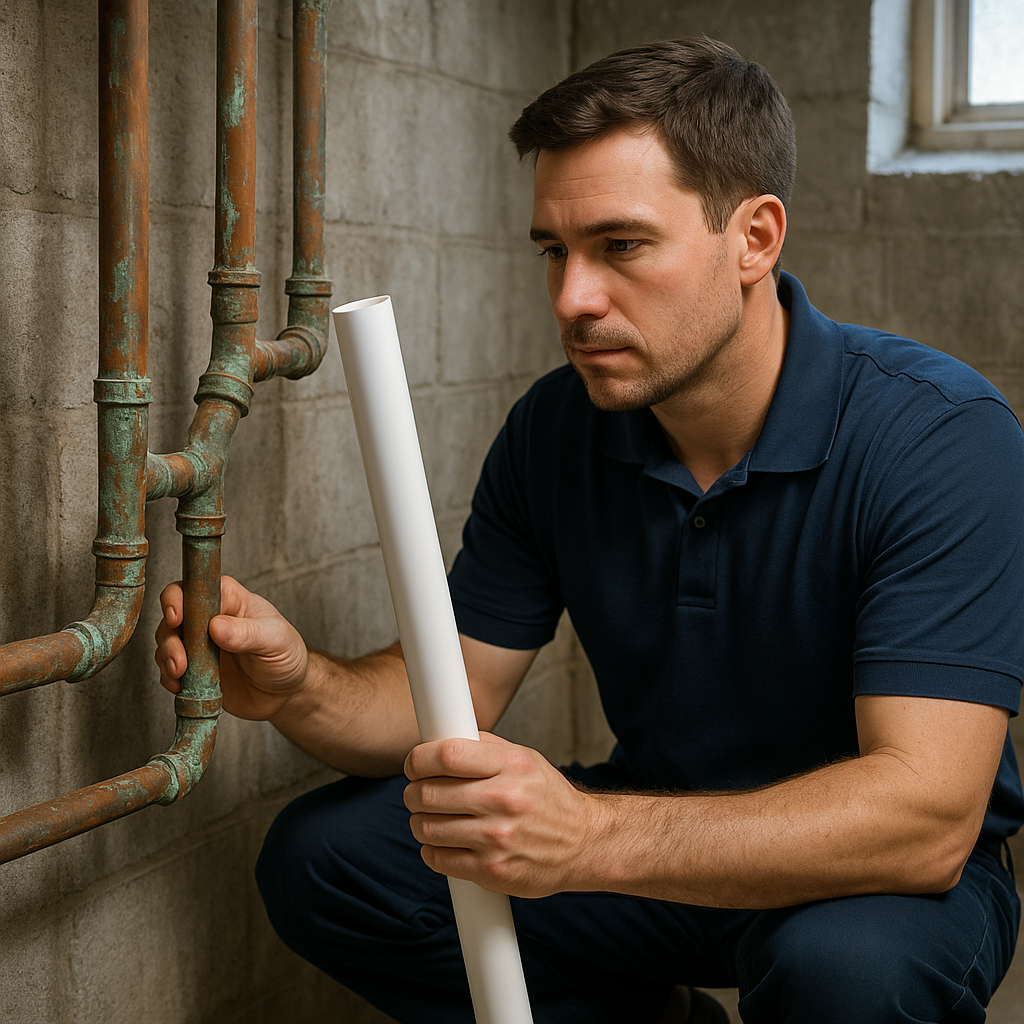
If you find more than one pinhole leak in older copper lines, the pipes may be near the end of their life. Read why PVC pipe replacement could be your best option for old copper plumbing.
When to Call a Plumber
Call right away if:
- Water is dripping through a ceiling or light fixture
- You find standing water on the floor and cannot find the source
- The water meter moves with everything off and the house shut-off valve closed
- You smell gas near the water heater
- Water is leaking near electrical outlets or the electrical panel
Shut off the main water valve and, if water is near electrical outlets or fixtures, turn off power to that area before you do anything else.
Schedule a visit soon if:
- Your water bill rose with no change in habits
- You see stains, bubbling paint, or soft spots on floors
- A musty smell will not go away
- Water pressure dropped throughout the house
- You found a leak you cannot reach or fix
How a Plumber Finds Hidden Leaks
A licensed plumber has tools that find leaks without opening up large sections of wall or floor:
- Acoustic leak detectors pick up the sound of water escaping from a pressurized pipe
- Thermal imaging cameras show temperature differences where water has soaked into walls or floors
- Moisture meters confirm whether drywall, wood, or flooring is wet
- Pressure tests isolate sections of the system to show which line is leaking
- Sewer and drain cameras show cracks, separated joints, and root intrusion in drain lines
This targeted approach means a smaller hole, a faster repair, and less damage to finishes.
What Happens If You Wait
A slow leak gets more expensive every week. Here is what can happen:
- Mold: The EPA advises homeowners to dry wet materials within 24 to 48 hours to prevent mold growth. A leak inside a wall keeps materials wet for much longer.
- Rot: Subfloors, sill plates, and framing lose strength when they stay damp.
- Pests: Carpenter ants and termites prefer damp, soft wood.
- Insurance problems: Many homeowners policies cover sudden water damage but exclude damage from slow, ongoing leaks. Read your policy and call your agent if you are unsure.
- Higher bills: Every day of a leak adds to your water bill, and a hot water leak adds to your energy bill too.
How to Prevent Slow Leaks
- Replace rubber washing machine hoses with braided stainless steel hoses
- Replace toilet flappers every few years
- Know where your main water shut-off valve is and test it once a year
- Drain and disconnect garden hoses before the first freeze
- Insulate pipes in crawl spaces, garages, and exterior walls
- Have a plumber check water pressure. Pressure that is too high stresses pipes and fittings
- Consider a smart leak detector or automatic shut-off valve near the water heater and washing machine
How to Choose a Plumber
Look for a licensed plumber with liability insurance and experience in leak detection. Ask how they plan to locate the leak, whether the estimate includes drywall or flooring repair, and what warranty comes with the work. Our article on how to hire a plumber lists the questions to ask before you sign.
Get Matched With a Top Plumber Near You
A slow leak is not the time to call five plumbers and wait for callbacks. My Licensed Contractor matches you with the best 5% of plumbers in your area. Tell us what you are seeing, whether that is a rising water bill, a stain on the ceiling, or a meter that will not stop moving, and we connect you with a licensed plumber who can find the leak and fix it.
Submit your plumbing request on My Licensed Contractor and get matched with a top-rated plumber near you.
Frequently Asked Questions
How can I tell if I have a hidden water leak?
Turn off all water in the house and check your water meter. If the leak indicator spins or the reading changes over 30 minutes to two hours, you have a leak. Other signs include a rising water bill, musty smells, stains, and soft floors.
What is the most common source of a slow leak?
Toilets are the most common source. A worn flapper lets water seep from the tank into the bowl around the clock. Supply lines under sinks and washing machine hoses are also common.
How long does it take for a slow leak to cause mold?
Wet materials can start to grow mold within 24 to 48 hours. A slow leak inside a wall can keep drywall and insulation wet for weeks, which gives mold plenty of time to grow.
Does homeowners insurance cover slow leaks?
Many policies cover sudden and accidental water damage, such as a burst pipe. Damage from a leak that went on for weeks or months is often excluded. Check your policy for details.
Can a plumber find a leak without opening the wall?
In many cases, yes. Plumbers use acoustic detectors, thermal cameras, and moisture meters to pinpoint the leak. They then open only a small area for the repair.
Is a slow leak an emergency?
A slow leak is not always an emergency, but it should not wait long. If water is near electrical outlets, coming through a ceiling, or causing standing water, shut off the main valve and call a plumber right away.
Find a Licensed Contractor
Connect with pre-screened, licensed contractors in your area.
Submit Your Project
Find Local Contractors
Connect with licensed, verified contractors in your area for your next project.
Submit Your Project