
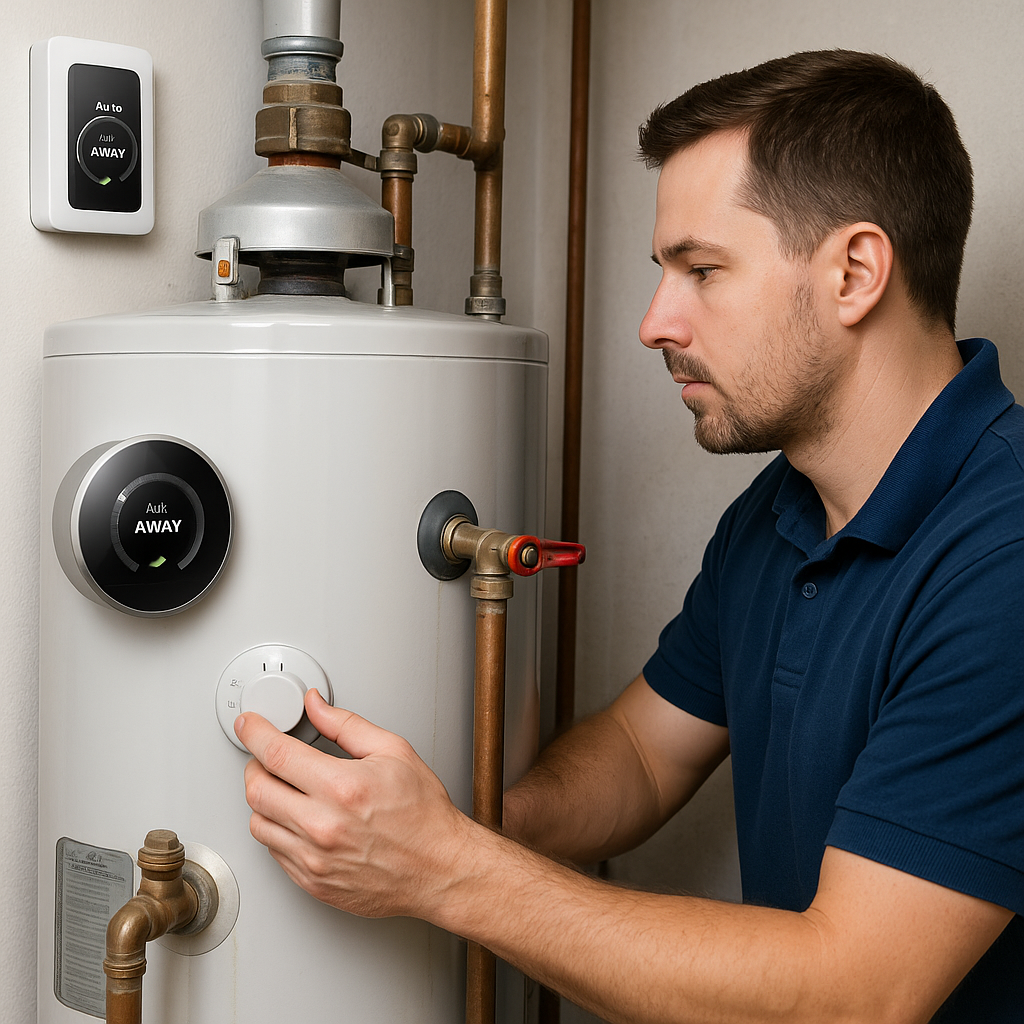
Water Heater FAQs: Repair, Replacement, Maintenance, Sizing & More
Is your water heater getting old? Are you noticing anything unusual, such as hot water running out faster than it should or strange noises coming from the tank?
This FAQ answers common homeowner questions about water heater repair, replacement, maintenance, sizing, energy efficiency, and when it is time to call a licensed plumber.
How long do water heaters last?
Most traditional tank-style water heaters last about 8 to 12 years, although lifespan depends on water quality, maintenance, usage, installation quality, and local water conditions. Tankless water heaters can last 15 to 20 years or more with proper maintenance because they do not store water continuously in a large tank.
If a tank water heater is near or beyond its expected lifespan, replacement may be more cost-effective than a major repair.
How do I know how old my water heater is?
Check the manufacturer’s label or serial number on the side of the unit. Many manufacturers encode the manufacture date in the serial number, although the format varies by brand. A plumber can also identify the approximate age and assess whether the unit is nearing the end of its useful life.
What temperature should my water heater be set to?
For most homes, 120°F is a practical setting that balances comfort, energy use, and scald prevention. The Consumer Product Safety Commission identifies 120°F as the upper safe limit because hotter water can cause burns very quickly, particularly for children and older adults.
Why is my water heater leaking?
A leak may come from a loose connection, drain valve, temperature-and-pressure relief valve, pipe fitting, condensation, or corrosion inside the tank. A leaking tank itself generally cannot be repaired and usually requires replacement.
Turn off the water supply if the leak is significant and call a plumber for an emergency water heater repair. For more signs that require quick professional help, read our guide to same-day home repair services and signs you need help today.
Should I repair or replace my water heater?
Repair may make sense when the water heater is relatively new and the problem involves a replaceable part, such as a thermostat, heating element, thermocouple, igniter, pressure-relief valve, or drain valve.
Replacement is often the better choice when the tank is leaking or corroded, repairs are becoming frequent, the unit is 8 to 12 years old, or it no longer meets your household’s hot-water needs.
When should a water heater be replaced instead of repaired?
Replacing your water heater may make sense if:
- The tank is leaking, rusting, or visibly corroded.
- Rust-colored water is coming from the hot-water side of the plumbing.
- The unit is near the end of its expected lifespan.
- Hot water runs out much faster than it used to.
- Repairs are expensive or recurring.
- You want lower energy bills or a larger hot-water capacity.
- You are remodeling, adding a bathroom, or expanding your household.
Can a leaking water heater tank be repaired?
Usually, no. If the tank itself has rusted through or developed an internal crack, replacement is the reliable solution. A plumber can determine whether the water is coming from the tank, a valve, a fitting, or the temperature-and-pressure relief valve before recommending replacement.
Is it worth repairing an old water heater?
It depends on the age, condition, repair cost, and efficiency of the unit. Replacing a small component on a newer water heater can be worthwhile. Investing heavily in a unit near the end of its service life may only delay replacement and increase the risk of a major leak or sudden failure.
What is a water heater flush?
A water heater flush is a maintenance service that drains water and sediment from the bottom of a tank-style water heater. If you live in an area with hard water, minerals in the water can settle in the tank over time.
Removing buildup can help preserve heating efficiency, reduce noise, support faster recovery, and extend the life of the unit.
How often should a water heater be flushed?
A typical recommendation is about once per year, but homes with hard water, high water usage, or noticeable sediment may benefit from more frequent water heater flushes. A plumber can recommend how often to flush your water heater after inspecting it.
What are signs my water heater needs to be flushed?
Your water heater may need a flush if you notice:
- Popping, rumbling, crackling, or banging sounds from the tank.
- Hot water that runs out faster than normal.
- Slower hot-water recovery after showers or laundry.
- Higher energy bills without a clear explanation.
- Cloudy or discolored hot water.
- Sediment visible when water is drained from the tank.
Can I flush my water heater myself?
Some homeowners can perform basic flushing on a conventional tank heater, but it is not always a simple DIY task. The work involves electricity or gas, very hot water, pressure, valves, drainage, and potentially sediment-clogged drain valves.
Do not attempt it if you are unsure how to safely shut down the unit, see active leaking, smell gas, have an older neglected tank, or lack a safe place to discharge hot water. A professional can flush the unit and inspect safety components at the same time.
If you are unsure whether a task is appropriate for DIY work, review which electrical jobs homeowners can actually DIY. While water-heater work has different hazards, the same basic rule applies: stop and call a qualified professional when gas, electrical wiring, pressurized systems, or safety components are involved.
Can flushing an old water heater cause a leak?
Flushing does not create corrosion, but an older tank may already have hidden rust or sediment that has been masking a weak area. If a leak appears after service, the tank was likely already near failure. This is one reason an older unit with no maintenance history should be evaluated carefully before flushing.
What are common signs of water heater problems?
You should call a plumber if you notice:
- No hot water or inconsistent hot water.
- Hot water running out unusually fast.
- Water that is too hot or not hot enough.
- Brown, rusty, cloudy, or foul-smelling hot water.
- Popping, rumbling, sizzling, or banging sounds.
- Water around the base of the unit.
- A pilot light that will not stay lit.
- A gas smell, burning smell, or signs of scorching.
- A temperature-and-pressure relief valve that is leaking or discharging water.
- Sudden increases in energy bills.
Why is my water heater making popping or rumbling noises?
Tank sediment is one of the most common causes. When mineral buildup collects along the bottom of the tank, water can become trapped beneath it and create popping or rumbling sounds as it heats.
A professional flush may help, but severe buildup can also indicate that the water heater is aging or losing efficiency.
Why is my hot water rusty or brown?
Rusty hot water can point to corrosion in the water heater tank, a deteriorating anode rod, or corrosion in plumbing pipes. If discoloration occurs only when using hot water, the water heater is more likely to be the source.
A plumber can inspect the anode rod, tank condition, and plumbing to identify the cause.
Why does my water heater smell like rotten eggs?
A sulfur or “rotten egg” odor can be caused by bacteria reacting with minerals in the water heater, often in homes with well water. The solution may involve flushing and disinfecting the tank, adjusting the anode rod type, or addressing water-quality concerns.
A plumber can help determine whether the source is the water heater or the incoming water supply.
Why is there no hot water?
For electric units, possible causes include a tripped breaker, failed heating element, thermostat problem, or wiring issue. For gas units, common causes include an extinguished pilot light, failed thermocouple, igniter issue, gas-supply issue, or burner problem.
Because water heaters involve high voltage, gas combustion, and pressurized hot water, professional diagnosis is the safest choice.
Why is water coming from the pressure-relief valve?
The temperature-and-pressure relief valve is a critical safety device. It may discharge because of excessive tank pressure, overheating, a malfunctioning valve, or a problem with the home’s plumbing pressure or expansion control.
Do not cap, plug, or disable the valve. If it is releasing water or steam, shut off the unit’s heat source if it is safe to do so and contact a qualified plumber.
What is the difference between a tank and tankless water heater?
A traditional tank water heater stores and keeps a supply of hot water ready for use. A tankless water heater heats water on demand as it flows through the unit.
Tank systems generally have a lower upfront cost and a simpler replacement process, while tankless systems can offer a longer lifespan, more compact installation, and potentially lower energy use for households with appropriate usage patterns.
| Feature | Tank water heater | Tankless water heater |
|---|---|---|
| Hot-water supply | Stored in a tank | Heated on demand |
| Upfront cost | Usually lower | Usually higher |
| Space needed | Larger footprint | Compact wall-mounted unit |
| Lifespan | Often 8–12 years | Often 15–20+ years with maintenance |
| Best sizing metric | Tank capacity and first-hour rating | Flow rate and temperature rise |
| Main limitation | Can run out during peak demand | Can be undersized for simultaneous use |
| Maintenance | Periodic tank flushing | Periodic descaling and maintenance |
Are tankless water heaters more energy efficient?
They can be, especially in homes that use modest amounts of hot water or want to avoid standby heat loss from storing water in a tank. Actual savings depend on household demand, fuel source, incoming water temperature, equipment efficiency, installation quality, and whether the unit is sized correctly.
Will a tankless water heater provide endless hot water?
A properly sized tankless unit can provide continuous hot water, but it does not provide unlimited flow. Its output is limited by gallons per minute and the temperature rise required.
If multiple showers, appliances, and faucets run at once, an undersized unit may not keep up.
Do tankless water heaters need maintenance?
Yes. Tankless systems should be professionally maintained according to manufacturer guidance, particularly in hard-water areas. Mineral scale can reduce performance and may require periodic descaling.
Gas vs. electric water heaters
Is a gas or electric water heater better?
Neither is automatically better for every home. The right choice depends on available utilities, energy costs, venting, electrical capacity, installation cost, household demand, and long-term efficiency goals.
| Consideration | Gas water heater | Electric water heater |
|---|---|---|
| Heat source | Natural gas or propane | Electricity |
| Recovery speed | Often faster for comparable tank sizes | Often slower for standard tank models |
| Installation needs | Gas piping, combustion air, and venting | Adequate electrical circuit and wiring |
| Upfront installation | May be higher if venting or gas work is needed | May be simpler where electric service is available |
| Operating cost | Depends on local gas pricing | Depends on local electricity pricing |
| Safety considerations | Combustion, venting, and carbon monoxide | Electrical shock and wiring risks |
| Efficient alternative | High-efficiency gas tankless | Heat pump water heater |
What is a heat pump water heater?
A heat pump water heater uses electricity to move heat from the surrounding air into the water rather than generating all heat directly with electric resistance elements. ENERGY STAR identifies heat-pump water heaters as a high-efficiency option, with qualified integrated models meeting high Uniform Energy Factor thresholds.
They work best when installed in an appropriate space with sufficient air volume and conditions that suit the equipment.
How do I size a tank water heater?
For a tank water heater, do not choose based only on gallons. Look at the first-hour rating, which estimates how much hot water the unit can provide during a busy hour.
Consider household size, number of bathrooms, shower habits, laundry use, dishwasher use, fixture flow rates, and whether several people use hot water at the same time.
How do I size a tankless water heater?
Tankless sizing depends primarily on:
- The number of fixtures or appliances likely to use hot water at the same time.
- The flow rate required, measured in gallons per minute.
- The temperature rise needed from incoming cold water to the desired output temperature.
For example, a home running two showers at once may need substantially more capacity than a home where only one shower or appliance runs at a time. Simultaneous showers, laundry, and dishwashing increase the required capacity.
What size water heater does a family of four need?
There is no one-size-fits-all answer. A family of four may need a tank system with a strong first-hour rating or a tankless system capable of supporting the home’s expected simultaneous demand.
The number of bathrooms, shower duration, laundry habits, incoming water temperature, and fixture flow rates matter as much as household size.
What should I consider before replacing a water heater?
Before choosing a replacement, consider:
- Current fuel type: gas, electric, propane, or heat pump.
- Tank, tankless, hybrid, or heat-pump design.
- Household size and peak-hour demand.
- First-hour rating for tank systems.
- Flow rate and temperature rise for tankless systems.
- Available space, venting, drains, and electrical capacity.
- Local permit and code requirements.
- Water quality and hard-water conditions.
- Energy-efficiency ratings, including Uniform Energy Factor.
- Warranty terms and expected maintenance needs.
- Whether an expansion tank, drain pan, new venting, or electrical upgrades are required.
Because replacement can involve plumbing, electrical, gas, venting, drainage, and local-code requirements, it is important to work with a qualified professional. Learn more about permits and contractors before starting a major home project.
Should I install the same size water heater I already have?
Not necessarily. Your existing unit may be oversized, undersized, inefficient, or no longer suited to how your household uses hot water. A professional should assess peak demand rather than simply replacing the old unit with the same gallon capacity.
Energy efficiency and insulation
What water heater features save energy?
Look for features and options such as:
- ENERGY STAR certification.
- A higher Uniform Energy Factor, or UEF.
- Heat-pump or hybrid technology.
- High-efficiency condensing gas technology.
- Tankless, on-demand heating when it matches household demand.
- Better tank insulation.
- Smart controls or vacation settings.
- A properly sized unit.
- Professional installation and maintenance.
ENERGY STAR uses UEF and performance requirements to identify qualifying water heaters, including storage, tankless, and heat-pump models.
Do I need a water heater insulation blanket?
A water heater insulation blanket, jacket, or insulation wrap can help reduce standby heat loss on some older tank-style models.
However, many newer water heaters already have good built-in insulation, so a blanket may offer limited benefit. Always consult the manufacturer’s guidance before adding one.
Can I put an insulation blanket on a gas water heater?
Use caution. Do not cover the top of a gas-fired water heater, the burner area, pilot-light access, air intake, draft hood, control panel, temperature-and-pressure relief valve, or drain.
When in doubt, ask a licensed plumber whether insulation is appropriate for the specific model.
Should I insulate hot-water pipes too?
Insulating accessible hot-water pipes near the water heater can reduce heat loss and may help hot water reach fixtures sooner. It is a relatively simple efficiency upgrade, but materials must be compatible with the pipe type and installed without interfering with safety equipment or service access.
Is water heater repair a DIY project?
Some low-risk tasks, such as visually checking for leaks, reviewing the temperature setting, clearing clutter around the unit, or testing whether a circuit breaker has tripped, may be manageable for homeowners.
Repairs involving electrical components, gas lines, combustion, venting, pressure-relief valves, internal tank parts, or installation should be left to qualified professionals.
Why should I hire a licensed plumber for water heater repair or replacement?
Water heater work can involve high-voltage electricity, natural gas or propane, combustion venting, carbon monoxide risk, pressurized hot water, scalding hazards, local plumbing codes, and permits.
A licensed plumber can correctly diagnose the problem, size the system, install safety components, confirm proper venting or electrical connections, and ensure the work aligns with applicable local requirements. Professional guidance is particularly important for gas systems and installations that may require permits or inspections.
Can I replace my own water heater?
Local rules vary, but replacement often involves permits, code requirements, safety devices, drainage, venting, fuel or electrical connections, and inspection requirements.
DIY installation can create safety risks, manufacturer warranty issues, insurance complications, and code violations if completed incorrectly. Contact your local building department and a licensed plumber before attempting replacement.
When is a water heater emergency?
Treat the situation as urgent if you smell gas, see flames outside the burner area, notice smoke or scorching, hear unusual roaring, see significant leaking, or observe steam or continuous discharge from the temperature-and-pressure relief valve.
If it is safe, shut off the fuel or power source, leave the area if you smell gas, and contact emergency services or a qualified plumbing professional. Do not tamper with a relief valve or try to cool an overheated unit with water.
How can I find a licensed plumber for a water heater repair or replacement?
Submit your project request on My Licensed Contractor. After selecting that you need a plumber, describe the issue you are experiencing with your water heater. If it is an emergency, you can indicate that you need help fast when submitting your project request.
Once you send your project, My Licensed Contractor will match you with a local vetted plumber who can help with your water heater.
Find a Licensed Contractor
Connect with pre-screened, licensed contractors in your area.
Submit Your Project
Find Local Contractors
Connect with licensed, verified contractors in your area for your next project.
Submit Your Project