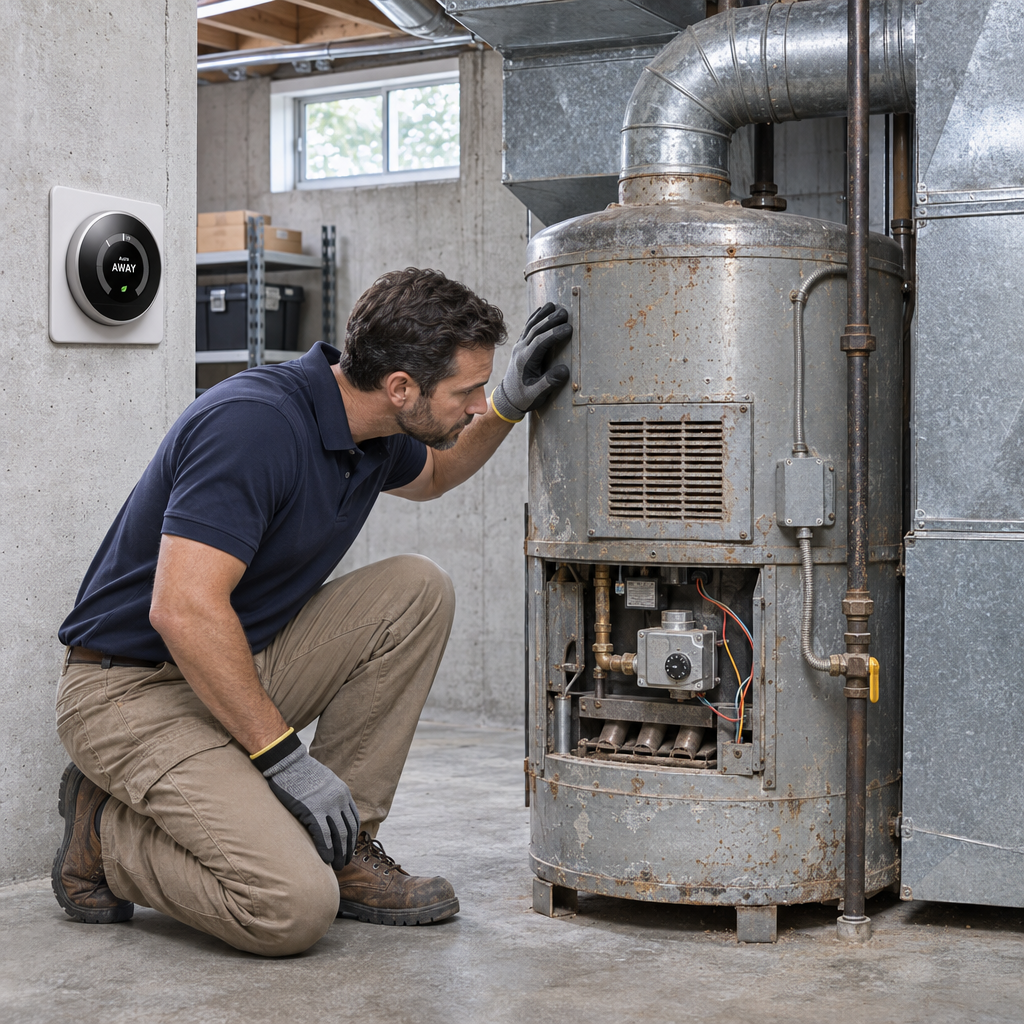
Repair or Replace? How to Decide What to Do With an Aging Furnace
Key Takeaways
- When an older furnace breaks down, homeowners often have to choose between a repair and a full replacement with very little time to think it through.
- The wrong decision can mean paying for repairs on a furnace that fails again next winter, or replacing a system that still had years of life left.
- This guide covers the factors that should drive the decision and the questions to ask before you commit.
A furnace rarely fails on a mild afternoon. It usually quits during the first hard cold snap, when it runs the longest. At that point you have a cold house, a technician in your basement, and a repair quote in your hand. It is hard to think clearly under that kind of pressure.
The good news is that the decision comes down to a few clear factors: the age of the furnace, the cost of the repair, how much the furnace costs to run, and whether it is still safe. If you understand these things before the furnace breaks, you can make the call in minutes instead of guessing.
How Long Does a Furnace Last?
Most gas furnaces last about 15 to 20 years with regular maintenance. Some last longer. Others fail early because of a poor installation, the wrong size unit, or years without service.
Age alone does not mean you need a new furnace, but it should definitely be something you consider. ENERGY STAR suggests that you replace a furnace when it's more than 15 years old, especially if it also needs frequent repairs or energy bills keep going up.
| Furnace age | What it usually means |
|---|---|
| 0 to 10 years | Repair is almost always the right choice. Check whether the part is still under warranty. |
| 10 to 15 years | Repair most problems. Start to compare large repair bills with the price of a new furnace. |
| 15 to 20 years | Weigh each repair carefully. A major repair often makes replacement the better choice. |
| 20+ years | Plan for a replacement. Repair only small, inexpensive problems to get through the season. |
To find the age of your furnace, look for the data plate inside the access panel. The serial number often includes the year of manufacture. If you cannot read it, an HVAC technician can tell you during a service visit.
Two Simple Rules of Thumb for Furnace Repairs and Replacements
Two quick formulas can help you see whether a repair makes financial sense. Neither one makes the decision for you, but both give you a starting point.
The $5,000 rule
Multiply the age of the furnace by the cost of the repair. If the result is more than $5,000, replacement usually makes more sense.
- A 16-year-old furnace with a $400 repair: 16 x $400 = $6,400. Consider a replacement.
- An 8-year-old furnace with the same $400 repair: 8 x $400 = $3,200. Getting your furnace fixes makes the most sense.
The 50% rule
If a repair costs more than half the price of a new furnace, and the furnace has passed the middle of its expected life, a replacement is usually the better value.
Both rules work best for gas furnaces in a typical home. If you have a boiler, a heat pump, or unusual ductwork, ask your HVAC contractor for a recommendation.
Common Furnace Repairs and What They Tell You
Some repairs are routine at any age. Others are a sign that the furnace is close to the end of its life.
| Repair | What it usually means |
|---|---|
| Igniter or flame sensor | Normal wear. Worth repairing at almost any age. |
| Thermostat problem | Often a thermostat issue rather than a furnace issue. Worth fixing. |
| Blower motor or capacitor | A moderate repair. Worth it on a younger furnace. On an older one, compare the cost with a replacement. |
| Gas valve or control board | A larger repair. On a furnace past 15 years, a replacement often makes more sense. |
| Cracked heat exchanger | A serious safety problem. Replacement is usually the only sensible option, especially once the warranty has ended. |
A cracked heat exchanger needs extra attention. The heat exchanger keeps combustion gases separate from the air that moves through your home. A crack can let carbon monoxide into your living space. If a technician finds one, ask to see a photo or the test result. If the furnace is fairly new, get a second opinion before you replace it.
Signs Your Furnace Is Near the End of Its Life
- You call for repairs every winter.
- Your gas bills keep going up even though your habits and the weather stay about the same.
- Some rooms stay cold while others get too warm.
- The furnace turns on and off often and never seems to reach the temperature on the thermostat.
- You hear banging, rattling, or squealing that comes back after repairs.
- The burner flame looks yellow or flickers. A healthy gas flame burns steady and blue.
- You see soot or rust around the furnace or the vent pipe.
- The house feels dry and dusty all winter.
One of these signs on its own does not mean you need a new furnace. Several of them together on a furnace that is more than 15 years old usually do.
Safety Comes First
Every fuel-burning furnace can produce carbon monoxide, a gas you cannot see or smell. The U.S. Consumer Product Safety Commission recommends that you have your heating system inspected and serviced every year and install CO alarms on every level of your home and outside sleeping areas.
Treat these situations as urgent:
- Your CO alarm goes off. Get everyone outside and call 911.
- You smell gas. Leave the house and call your gas utility from outside.
- People in the house get headaches, nausea, or dizziness that improve when they leave.
Our guide to the signs of a gas leak explains what to watch for and when to call a pro.
If a technician tells you the furnace is unsafe to run, take that seriously. Ask for the specific problem in writing. A safety problem on an older furnace is one of the clearest reasons to replace it.
What an Older Furnace Costs You to Run
The industry rates furnace efficiency by annual fuel utilization efficiency, or AFUE. A furnace with an 80% AFUE rating turns 80% of its fuel into heat for your home. The other 20% goes out the vent.
Many older furnaces run at 56% to 70% AFUE. Standard new gas furnaces start at 80% AFUE, and high-efficiency condensing furnaces reach 90% to 98.5%.
| Furnace efficiency (AFUE) | Heat you get from every $100 of gas |
|---|---|
| 60% | $60 |
| 80% | $80 |
| 95% | $95 |
The gap matters most in cold climates, where the furnace runs for months at a time. In Indiana and the rest of the Midwest, an upgrade from an old 60% furnace to a 95% model can cut the gas you use for heat by more than a third.
Efficiency alone rarely justifies the replacement of a furnace that works well. It does tip the scale when you face a large repair on an old, inefficient unit.
When a Furnace Repair Makes Sense
- The furnace is less than 10 to 12 years old.
- The repair is small, such as an igniter, a flame sensor, or a capacitor.
- The part is still under warranty.
- The furnace has a good service history and heats the house evenly.
- You plan to move within a year or two, and the repair will get you through.
Regular maintenance keeps a repaired furnace in good shape. Our article on why you should schedule a heating tune-up before winter explains what a tune-up includes and how it can prevent breakdowns.
When a Furnace Replacement Makes Sense
- The furnace is more than 15 years old and needs a major repair.
- The repair fails the $5,000 rule or the 50% rule.
- The technician finds a cracked heat exchanger or another safety problem.
- You have paid for repairs several winters in a row.
- Your gas bills keep rising and some rooms never get comfortable.
- You plan to stay in the home for many years.
A replacement also gives you a chance to fix problems the old furnace had, such as weak airflow, leaky ducts, or a unit that was the wrong size for the house from the start.
What to Know Before You Replace a Furnace
Ask for a load calculation
A good HVAC contractor sizes a new furnace with a heat load calculation, often called a Manual J. This calculation looks at your home's square footage, insulation, windows, and air leaks. An oversized furnace turns on and off too often. An undersized furnace runs nonstop on the coldest days and still leaves the house cold.
Compare efficiency levels
An 80% furnace costs less to buy and install. A 95% condensing furnace costs more upfront but uses less gas every winter. Condensing furnaces also need PVC vent pipes and a drain for condensate, so the installation can change. Ask your contractor to show you the price difference and an estimate of the yearly gas savings for your home.
Consider a heat pump or a dual-fuel system
Some homeowners pair a heat pump with a gas furnace. The heat pump heats the house on mild days, and the furnace takes over in deep cold. Ask your contractor whether this setup makes sense for your home and your utility rates.
Check rebates and financing
Many gas and electric utilities offer rebates for high-efficiency furnaces and heat pumps. Check your utility's website and ask your contractor before you choose a model. Many HVAC contractors also offer financing, which can make a high-efficiency furnace easier to fit into your budget.
Compare quotes line by line
When you compare quotes, look at what each one includes: removal of the old furnace, the permit, a new thermostat, any duct or vent changes, and the labor warranty. A quote that looks cheaper may leave some of these out. Our guide on when a low bid is actually more expensive explains what to watch for.
Questions to Ask Your HVAC Contractor
- What exactly is wrong with the furnace, and can you show me?
- What will the repair cost, and what warranty comes with it?
- How much life do you think this furnace has left?
- If I replace it, what size and efficiency do you recommend, and why?
- Does your quote include the permit, removal of the old unit, and a new thermostat?
- Does the model you recommend qualify for any utility rebates?
A good contractor will answer these questions in plain language and will not pressure you to decide on the spot unless there is a real safety problem.
Get Matched With a Top HVAC Contractor Near You
Whether you need a repair or a new furnace, the decision is easier when you trust the person who gives you the advice. My Licensed Contractor matches you with the best 5% of HVAC contractors in your area. Describe your furnace problem once, and we connect you with a licensed pro who can inspect your system and give you an honest recommendation.
Submit your HVAC request on My Licensed Contractor and get matched with a top-rated HVAC contractor near you.
Frequently Asked Questions
How long does a furnace last?
Most gas furnaces last 15 to 20 years. Yearly maintenance helps a furnace reach the upper end of that range. Poor installation or skipped service can shorten it.
Is it worth repairing a 20-year-old furnace?
Only for small, inexpensive repairs that get you through the season. For anything larger, a 20-year-old furnace is usually a better candidate for replacement.
What is the $5,000 rule for furnaces?
Multiply the age of the furnace by the repair cost. If the total is more than $5,000, a replacement usually makes more financial sense than the repair.
Can a cracked heat exchanger be repaired?
In most cases, no. A cracked heat exchanger can let carbon monoxide into your home, and most contractors recommend a replacement of the heat exchanger or the whole furnace. On an older furnace, a full replacement is usually the better value.
Should I replace my air conditioner at the same time as my furnace?
If your air conditioner is about the same age as your furnace, replacing both at once can save on labor and gives you equipment designed to work together. If the air conditioner is fairly new, you can usually keep it.
How often should a furnace get serviced?
Once a year, ideally in early fall before you need heat. The U.S. Consumer Product Safety Commission recommends a yearly professional inspection of all fuel-burning heating systems.
Find a Licensed Contractor
Connect with pre-screened, licensed contractors in your area.
Submit Your Project
Find Local Contractors
Connect with licensed, verified contractors in your area for your next project.
Submit Your Project