The Trust Gap: How Reviews, Badges, and Credentials Turn Skeptical Leads Into Calls
Key Takeaways
- Before a homeowner hires a contractor, they need to know the business is trustworthy.
- Reviews, badges, credentials, and real project photos help build this trust.
- We share tips and strategies for leveraging these elements to build trust and get more calls.
Homeowners rarely pause before hiring because your price feels too high. They pause because they do not know who will show up at their door, whether the work will hold up, and whether you will honor the estimate you gave them.
That hesitation has a name: the trust gap. Closing it is less about luck and more about the proof you put in front of homeowners before they ever call you.
By the end of this post, you will have a simple trust-signal audit and a prioritized action plan you can start this week.
What Trust Signals Are and Why the Trust Gap Exists
A trust signal is any visible, verifiable proof point that answers the quiet question running through every prospect’s mind: Can I trust this company with my home, my budget, and my timeline?
Your work carries real risk for a homeowner. The tickets are large, much of the work cannot easily be undone, strangers walk through their house, and timelines can feel uncertain. Many homeowners also worry about being overcharged, surprised by change orders, or left with a half-finished job.
You can break the trust gap into three buyer fears:
- Competence: Can they actually do this work well?
- Integrity: Will they be honest about price, scope, and problems?
- Reliability: Will they communicate, show up, and finish?
Good trust signals move the burden of proof off the homeowner and onto you. Instead of asking people to take your word for it, you show them evidence. That single shift changes how every sales conversation begins.
For homeowners who are still deciding whether to hire a pro at all, finding a contractor shouldn’t feel like a guessing game. Trust signals are how you become the obvious, lower-risk choice.
Why Trust Signals Directly Affect Your Revenue
Trust touches every step of your sales funnel. When your credibility is strong, more people fill out your form, request a call, and book an estimate. More of those estimates turn into signed jobs, and those jobs are often larger.
Trust also lowers price sensitivity. A homeowner will often pay more for a contractor who feels safer, more established, and more accountable. The cheapest bid loses its grip when someone believes you will actually deliver.
Strong positioning improves lead quality, too. When you look like a professional, you attract clients who value professionalism instead of chasing the lowest number. Those clients tend to be easier to work with and happier at the end of the project.
Then the effect compounds. Happy clients refer their neighbors, return for future work, and reinforce your reputation. Trust signals remove friction before the sales conversation even begins.
This matters especially when homeowners are comparing bids. As we explain in why a low bid can actually be more expensive, the lowest number is not always the safest choice. A credible contractor website makes that easier for homeowners to understand.
Low-Trust vs. High-Trust Contractor Websites
Homeowners form an impression quickly. Before they read your services or call your office, they are scanning for signs that you are established, legitimate, and safe to hire.
A high-trust website does not need to be fancy. It needs to make the homeowner’s decision easier by answering their concerns before they have to ask.
Online Reviews: Your Most Powerful Social Proof
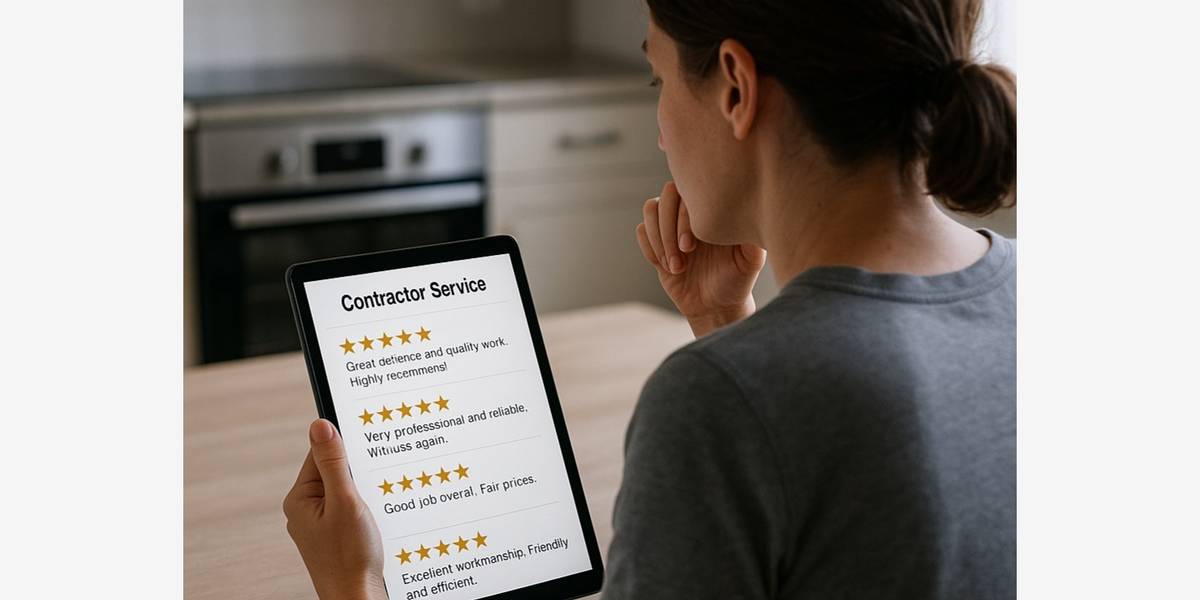
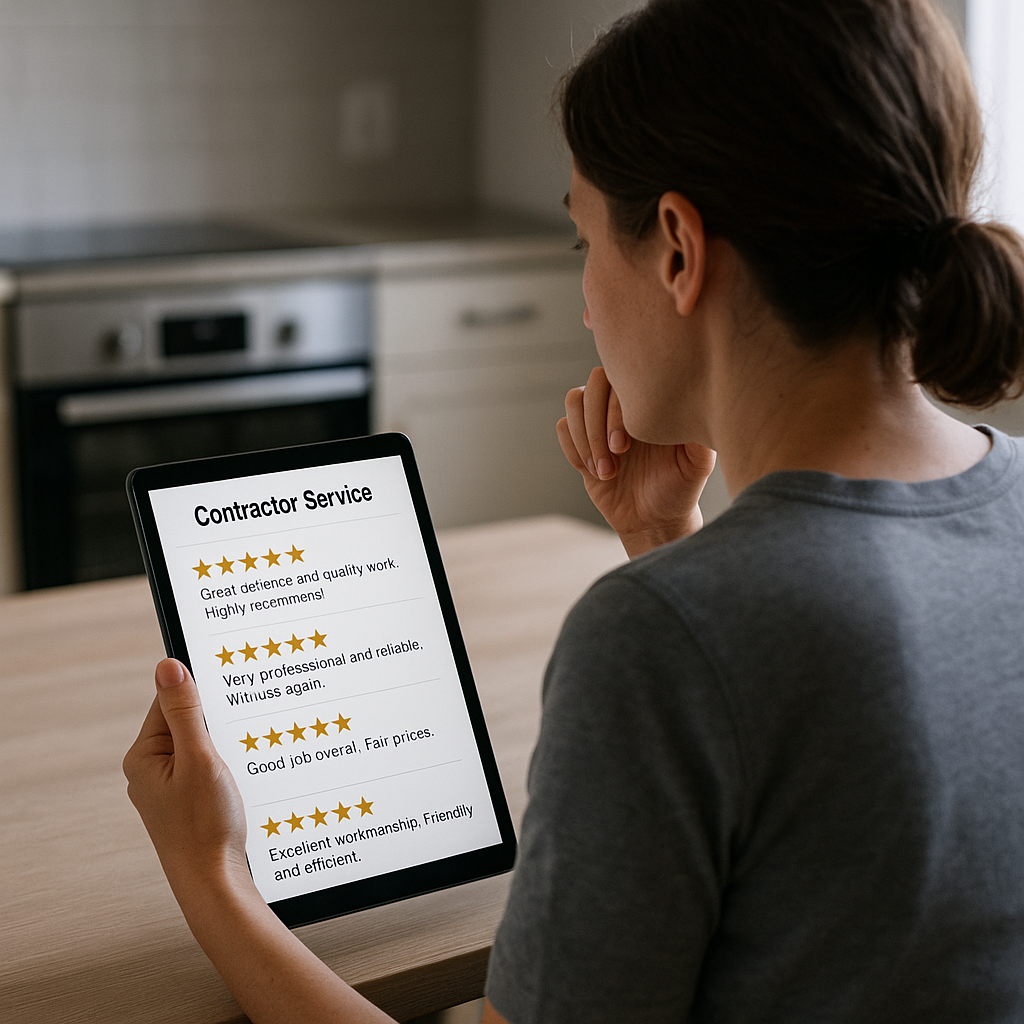
So, do homeowners check reviews for contractors? Almost always. Reviews are usually the first trust checkpoint. People compare companies on Google, Maps, Facebook, Yelp, and other directories long before they contact anyone.
The star rating matters, but several other factors matter just as much:
- Quantity: Enough reviews show that you are an established business.
- Recency: Recent reviews prove you are active today.
- Specificity: Detailed reviews mentioning your crew, communication, cleanup, pricing, and final result are more persuasive than one-line praise.
- Response behavior: Professional replies show accountability and customer care.
Google has noted that review volume, ratings, and owner responses can contribute to local visibility, while a complete and accurate Business Profile strengthens customer trust. Recent review activity also matters because a steady flow of new reviews signals that your business is currently operating and serving customers.
A Simple Review-Request System
Getting reviews becomes easier when you follow the same process every time:
- Ask right after a successful milestone or the final walkthrough.
- Send a direct review link by text or email so it takes only seconds.
- Make the ask personal, such as: “Would you mind sharing your experience with our roof replacement and cleanup?”
- Follow up once, politely, without pressuring anyone.
For a deeper review-generation process, see how to get more reviews for your home service business.
Responding to Negative Reviews
A negative review is not the end of the world. How you respond tells future readers everything.
Acknowledge the issue without becoming defensive. Move detailed account information to a private channel, such as a phone call. Offer a clear next step so future readers see that you solve problems instead of ignoring them.
The way you handle a difficult moment in public becomes proof of your integrity. A calm, professional response can rebuild trust and sometimes earn a recommendation.
Reviews are powerful, but they are not the only trust signal. For a broader perspective, read the problem with contractor reviews and what to use instead.
Trust Badges: The MLC Contractor Badge and Beyond
Badges work because they provide instant, third-party validation. When a homeowner compares several companies they have never heard of, a recognizable badge tells them someone else has already evaluated your business.
The My Licensed Contractor badge is a vetted credibility marker. My Licensed Contractor uses proprietary technology to vet contractors, and only the best 5% make it onto the platform. When you claim your free profile, you receive a badge you can display on your website as proof that you are among that top 5%.
That matters because homeowners want reassurance before they call you. A badge gives a skeptical prospect a fast reason to feel safer choosing you.
Different badges do different jobs:
- Association or network badges: Such as the MLC Contractor Badge.
- Accreditation badges: Such as BBB accreditation.
- Manufacturer certifications: Authorized-dealer or installer designations.
- Insurance, bonding, and licensing verifications: Proof that you meet baseline professional standards.
- Platform verification badges: Third-party validation from relevant industry platforms.
Place badges where homeowners make decisions: near the top of your homepage, on service pages, in estimate and proposal templates, in your email signature, and on your Google Business Profile where appropriate.
Avoid badge clutter. Show only current, relevant, recognizable credentials, and add one short line explaining what each badge means. A logo alone rarely tells the full story.
My Licensed Contractor has screened more than half a million home service professionals using a technology-driven screening system designed to identify qualified, licensed contractors with strong customer track records.
Credentials, Licensing, and Insurance Proof
Transparency is a competitive advantage. Many homeowners want to confirm your license and insurance, but they feel awkward asking. When you publish that information first, you remove the awkward moment and look confident at the same time.
Consider displaying:
- Your license number and issuing state, where applicable.
- Bonding information.
- General liability insurance.
- Workers’ compensation coverage.
- Manufacturer and relevant trade certifications.
- Permits and inspection practices, where relevant to your trade.
You do not want to overwhelm visitors with paperwork. Create one dedicated page, such as “Credentials” or “Our Standards,” then link to it from your service pages and proposals. Pair the facts with plain-English reassurance, such as “Fully insured for your protection” or “Licensed and background-checked technicians.”
Keep everything current. An expired badge, outdated license details, or mismatched business information can quietly damage the exact trust you built those assets to create.
To help homeowners understand why this matters, link to licensed, bonded, and insured: what these three words actually mean. You can also connect licensing to real homeowner risk with can hiring an unlicensed electrician affect your insurance claim in Indianapolis?
For contractors who handle permitted work, permits and contractors: how to make sure your home project is done right is another useful internal resource.
Portfolio, Case Studies, and Before-and-After Proof
Visual proof is the bridge between what you claim and what homeowners believe. People want to see work on homes like theirs, completed by a team that understands their type of project.
Older housing stock, for example, often hides surprises behind walls, under floors, or around outdated systems. A homeowner in an older neighborhood wants to see that you have handled homes of that age before.
Organize your portfolio so visitors can find relevant work quickly. Sort projects by:
- Service type.
- Project size or budget range.
- Neighborhood or service area.
- Common customer problem.
Then turn photos into short case studies using a repeatable format:
- The problem: What the homeowner was dealing with.
- The solution: What your team recommended and completed.
- The timeline: How long the work took.
- The result: The finished outcome, supported by a short customer quote.
Tie testimonials to real project images whenever possible. Praise connected to a visible job feels credible; a floating quote often feels generic.
Video raises the bar even higher. Short walkthroughs, crew introductions, project timelapses, and quick customer interviews make your company feel present and accountable.
Keep it authentic. Use real project photos, real team members, and specific details. Overly polished, stock-style content can actually feel less believable.
Your Website, Communication, and Brand Consistency
Trust begins before the first phone call. A slow, outdated, or confusing contractor website plants doubt even when your craftsmanship is excellent. Homeowners judge your business by the first thing they can see, and often, that is your website.
Your website should include:
- Fast, mobile-friendly design.
- Clear service pages.
- A visible phone number and easy contact options.
- Real team photos and an honest About page.
- Accessible reviews and testimonials.
- A transparent process and clear next steps.
- Service-area information.
- Guarantees, warranties, and risk-reducing policies where you can back them up.
Trust continues through communication. Answer calls, forms, and messages quickly and professionally. Set clear scheduling expectations. Send branded estimates and proposals. Keep your tone consistent across your website, Google Business Profile, social media, email, and invoices.
Local consistency matters, too. Your business name, address, phone number, hours, and service information should match everywhere. When your website and Google Business Profile agree, both customers and search engines recognize you as a legitimate business.
Clear communication also reduces one of the biggest sources of homeowner anxiety: surprise costs. See how home service contractors can prevent change-order surprises for a practical companion topic.
How to Audit and Strengthen Your Trust Signals
The best audit is simple: look at your brand the way a skeptical homeowner would, starting with the first Google search and ending with the final proposal.
A Five-Step Trust Audit
- Search your company name and main service in Google.
- Review your Google Business Profile, including reviews, photos, and your responses.
- Visit your homepage and top service pages on a phone.
- Submit a test inquiry and judge your own response speed and quality.
- Read one of your estimates as if you were receiving it for the first time.
Your Quick-Win Priority List
Once you see the gaps, work through the fixes that move the needle fastest:
- Claim and complete your Google Business Profile.
- Request reviews from recent happy customers.
- Respond to any reviews you have left unanswered.
- Add license, insurance, and certification proof to key pages.
- Replace stock images with real project and team photos.
- Add the MLC badge and other meaningful credentials where buyers make decisions.
- Build one strong before-and-after case study.
- Make your phone number, contact options, and service area impossible to miss.
After the quick wins, set up a continuous proof-collection system so you never run dry. Capture photos and customer quotes during each job, refresh your portfolio and Google Business Profile quarterly, and track calls, forms, booked estimates, and closed jobs by source.
The core message is this: trust is not a one-time checkbox on your website. It is an operating system for how you collect, display, and maintain proof over time.
If homeowner hesitation is a recurring problem, why homeowners hesitate to hire you and how to fix it pairs directly with this post.
Let Us Help You Close the Trust Gap
At My Licensed Contractor, we help contractors turn skeptical leads into paying clients by making their credibility easy to see and easy to believe.
Our proprietary technology vets contractors, and only the best 5% make it onto the platform. When you claim your free profile, you receive an MLC badge you can display on your website as third-party proof that you belong to that top tier.
If you are ready to become the trusted contractor homeowners feel confident calling, claim your free My Licensed Contractor profile today.
FAQ
How many reviews do I need to look trustworthy?
There is no magic number, but a steady stream matters more than a single burst. A handful of recent, detailed reviews often beats a large pile of old ones because recency shows homeowners that you are active today. Keep asking after every completed job so your review count grows naturally over time.
Should I respond to every review, even positive ones?
Yes, when you can. A short, genuine thank-you on a positive review shows that you pay attention. On a negative review, a calm and professional reply shows future readers how you handle problems, which can rebuild trust and sometimes win back the customer.
Where should I place trust badges on my website?
Put them where homeowners make decisions: near the top of your homepage, on service pages, in proposals, and in your email signature. Add one short line explaining each badge, and display only credentials that are current and relevant so you avoid clutter.
What is the fastest trust fix I can make this week?
Claim and complete your Google Business Profile, then ask your last few happy customers for a review using a direct link. Those two steps can quickly improve both your visibility and credibility, since many homeowners check your profile before they ever call.
Do trust badges really matter if I already have good reviews?
Yes. Reviews show that past customers were happy; badges add third-party validation. A badge such as the MLC Contractor Badge tells homeowners that your business has been vetted through My Licensed Contractor’s proprietary screening process and is part of its top 5%.
How do I prove I am licensed and insured without overwhelming visitors?
Create a simple “Credentials” or “Our Standards” page with your license number, insurance coverage, bonding information, and certifications. Then link to that page from your homepage, service pages, and proposals. Use plain-English reassurance alongside the details.
What should a high-trust contractor website include?
At minimum, it should include a fast mobile experience, clear services, visible contact information, recent reviews, real photos, team information, credentials, a transparent process, and clear next steps. The goal is to answer a homeowner’s concerns before they have to ask.
How often should I update my trust signals?
Review your Google Business Profile, website credentials, badges, portfolio, and business information at least quarterly. Update immediately whenever your insurance, licensing, certifications, team, service area, or branding changes.
Can a strong website really help me win higher-value jobs?
Yes. A high-trust website attracts homeowners who value professionalism, clear communication, and accountability. That can lead to better-fit leads, stronger close rates, and larger projects.
How do I know which trust signals are working?
Track phone calls, form submissions, booked estimates, closed jobs, and revenue by traffic source. Then compare periods before and after major trust improvements, such as adding reviews to service pages, publishing case studies, or displaying your MLC badge.
```Find a Licensed Contractor
Connect with pre-screened, licensed contractors in your area.
Submit Your Project
Find Local Contractors
Connect with licensed, verified contractors in your area for your next project.
Submit Your Project